
After a tropical storm, many Spring owners find a stain on the ceiling and nothing visibly wrong on the roof. No missing shingles, no fallen limbs. The culprit is usually wind-driven rain: water pushed sideways and even uphill by strong wind, into places a roof is only designed to shed water from above.
How Sideways Rain Gets In
A shingle roof works like overlapping scales: each course laps over the one below, and water runs down and off. That design assumes water falls more or less vertically. In a tropical storm or a strong squall line, wind can drive rain horizontally for hours, forcing it:
- under the edges of shingles whose seal strips have weakened
- up and under ridge vents and box vents
- through gaps at step flashing along second-story walls
- behind siding where a kick-out flashing is missing
- around windows and skylights set in the roof plane
| Entry point | Where the stain shows |
|---|---|
| Ridge vent | Ceiling near the center of the house |
| Step flashing at a wall | Ceiling or wall below the second-story junction |
| Missing kick-out | Wall stains, rot behind siding |
| Box vents | Ceiling below each vent |
| Skylight | Around the skylight well |
Why It Shows Up Later
A wind-driven leak may only appear during storms from one direction. Ordinary rain can fall on the same roof for months without a drip. Then a storm comes from the southeast, as Gulf systems often do, and water finds the gap. That's why the stain seems to come from nowhere.
From the ground: note the date and the wind direction of the storm that caused the stain.
Ask the roofer: "Which side of the roof faced the wind in that storm, and what's on that side?"
Finding It
A roofer traces a wind-driven leak from the attic up: water stains on rafters and the underside of the decking point toward the entry. Sometimes a careful water test, spraying one area at a time from the right direction, is needed to reproduce it. See roof repair.
Fixing It
| Cause | Fix |
|---|---|
| Ridge vent without baffles | Replace with an externally baffled ridge vent |
| Weak seal strips | Hand-seal or replace the shingles |
| Step flashing gaps | Re-flash the wall junction |
| Missing kick-out flashing | Install one at the bottom of each roof-to-wall joint |
| Old box vents | Replace with sturdier, storm-ready designs |
Getting Ready for Storm Season
Hurricane season runs June through November. Ready.gov lists steps to prepare a home, including the roof: Ready.gov: Hurricanes. For Beryl's effect on Spring, see Beryl and trees.
Around Spring
Newer two-story houses in Harmony and around Atascocita often trace leaks to wall flashing and kick-outs, while Conroe and Humble see more at older vents. Low patio roofs have their own version of the problem; see low-slope roofs.
Clues Inside the House
- A stain that grows only in certain storms: wind-driven rain from one direction.
- Water on a wall, not a ceiling: flashing at a roof-to-wall joint, or a missing kick-out.
- Damp insulation near the ridge: the ridge vent is letting water in.
- Rings around a skylight well: skylight flashing or the skylight's own seals.
- Swollen window trim on a second story: water behind the siding from the roof joint above.
Take photos of each stain with the date, and note the storm's direction if you know it. A roofer reading the stains alongside the weather can often narrow the leak to one joint.
Second-Story Walls and Kick-Outs
Spring two-stories almost always have places where a lower roof runs into an upper wall: over a garage, a porch or a first-floor room. Along that line, step flashing is woven in with each course of shingles. At the bottom, where the roof edge meets the wall, a small bent piece called a kick-out flashing should steer water into the gutter. Without it, water from the whole upper wall runs behind the siding, into the wall cavity, and often down to a window or door below. It's one of the cheapest parts on a roof and one of the most often missing.
Questions
Does insurance cover wind-driven rain damage?
Many policies cover rain damage only when wind or hail first creates an opening in the roof. Read your policy wording.
Can a new roof still leak in sideways rain?
Yes, if flashing, kick-outs or vents aren't installed correctly. That's why the details matter on a new roof.
How can I tell wind-driven rain from a roof hole?
A leak that only appears in storms from one direction, with no visible damage, points to wind-driven rain.
Does a ridge vent always leak in a storm?
No. A properly installed, externally baffled ridge vent sheds sideways rain well. Older or poorly fitted ridge vents without baffles are the ones that let water in during strong storms.
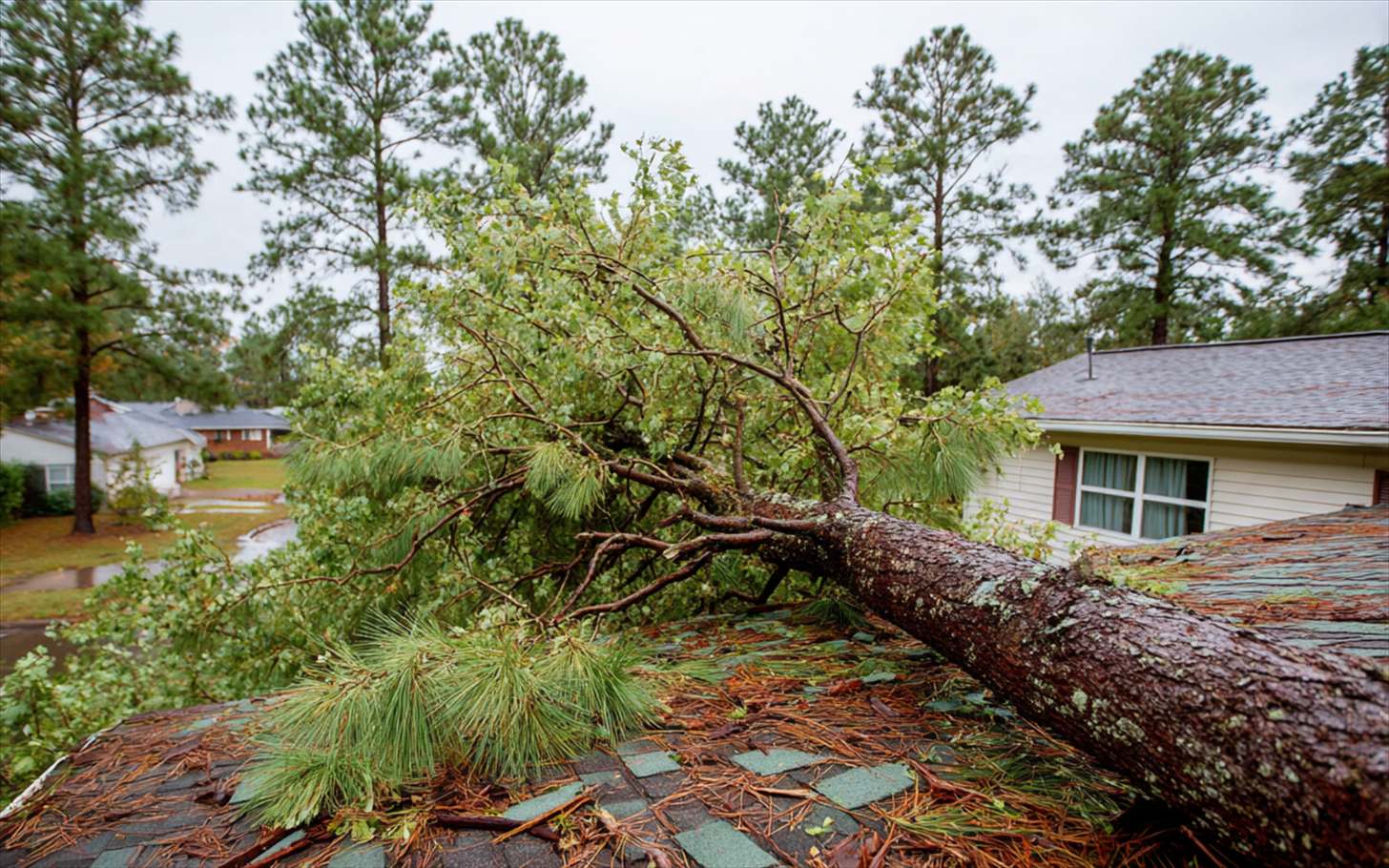
Hurricane Beryl and Trees on Spring Roofs
What the July 2024 storm left on Spring houses.

Low-Slope Roofs Over Patios and Additions
Flat-looking roofs, ponding water and the joint with the house.