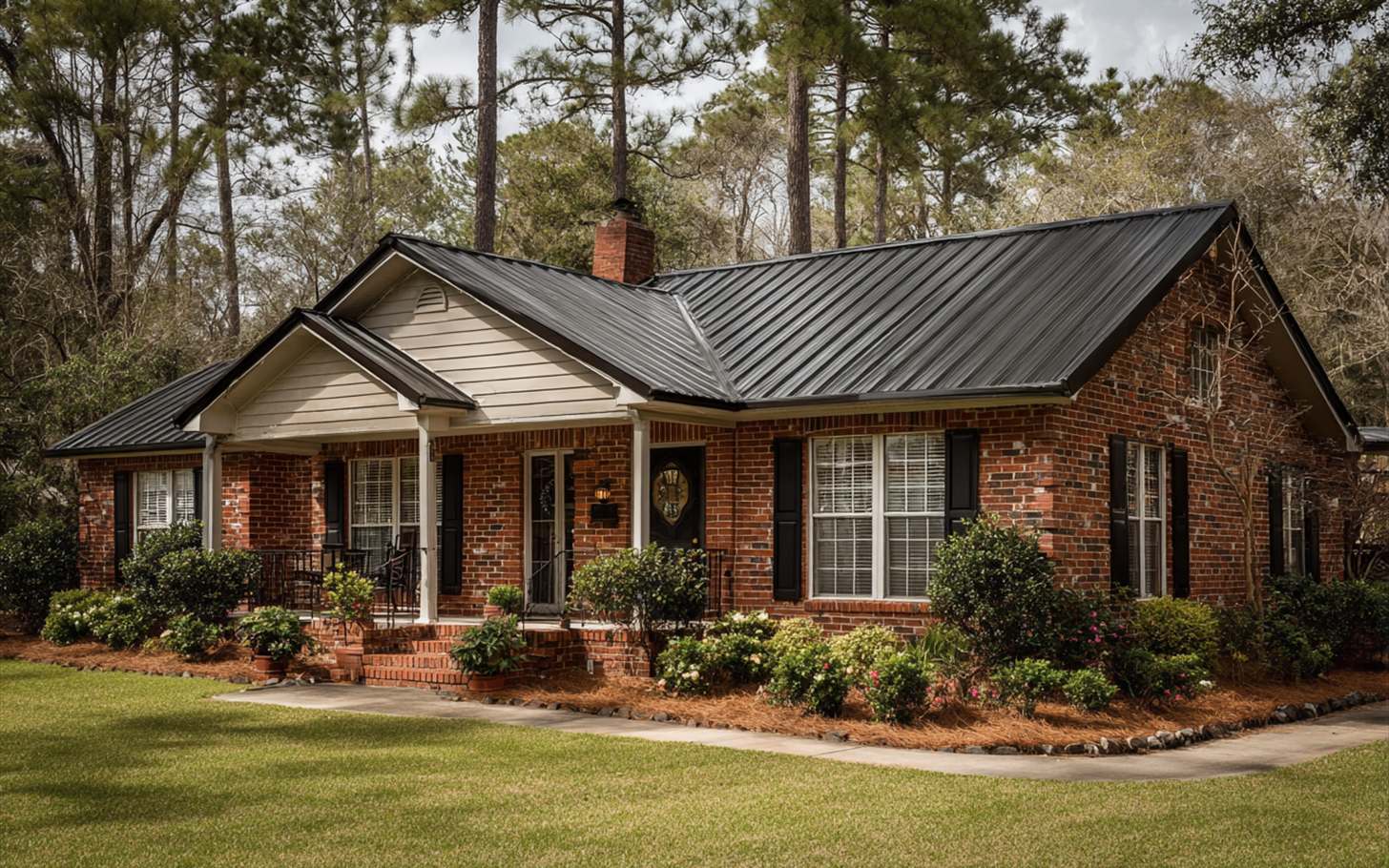
Standing Seam and Exposed-Fastener Metal
Metal roofs in Spring come in two main kinds: standing-seam panels, joined at raised seams with hidden clips, and exposed-fastener panels screwed straight through the face. Standing seam costs more and needs less upkeep; exposed-fastener panels are common on barns, shops and porches and need their screws checked over time. For metal roofing or a low-slope roof, call (346) 301-2240 and an independent roofing company that works in Spring picks up.
| Standing seam | Exposed fastener | |
|---|---|---|
| How it's held down | Concealed clips under raised seams | Screws with rubber washers through the panel |
| Upkeep | Low | Screws and washers loosen and age |
| Expansion in heat | Panels slide on their clips | Screw holes can elongate |
| Typical use in Spring | Whole-house replacements, porches, Old Town Spring buildings | Sheds, shops, patio covers |
| Cost | Higher | Lower |
From the ground: if you can see rows of screw heads across the panels, it's exposed fastener.
Ask the roofer: "Which system are you proposing, and what does it need over the years?"
Metal, Hail, Heat and the HOA
Metal sheds needles and rain well, handles high winds when fastened correctly, and lasts far longer than asphalt. Hail can dent it, which is mostly cosmetic but shows; some panels carry impact ratings. In summer, light-colored or coated metal reflects much of the sun's heat.
In master-planned neighborhoods, a metal roof needs association approval, and some guidelines limit colors or allow metal only on porches. Raise it with the HOA before choosing.
From the ground: look at metal roofs in your own neighborhood; that tells you what the HOA has approved before.
Ask the roofer: "What gauge and finish, and does it carry an impact rating?"
Patio Covers, Additions and Low-Slope Roofs
Many Spring houses have a section that is nearly flat: a covered patio, a sunroom, a back-porch addition, or a garage extension. Shingles don't work on very low slopes, because water moves too slowly and backs up under them. These roofs need a membrane:
- TPO: a white single-ply sheet, heat-welded at the seams, common on newer patio roofs.
- Modified bitumen: a rolled, asphalt-based membrane, torched or self-adhered, common on older additions.
- Low-slope metal: standing seam can work on surprisingly shallow pitches when the right panel is used.
More: low-slope roofs over patios.
Ponding and Drainage
Water that stands on a low-slope roof for more than a day or two after rain is called ponding. It ages the membrane, adds weight, and finds every weak seam. On Spring patio roofs it usually comes from a slope that's too shallow, a sagging frame, gutters clogged with needles, or a low spot where the patio roof meets the house.
The fix depends on the cause: tapered insulation or re-framing to add slope, a new gutter or scupper, or rebuilding the low corner.
From the ground: after a rain, look down from an upstairs window at the patio roof and note where the water sits.
Ask the roofer: "Where is the water supposed to drain off, and why isn't it?"
Where a Low Roof Meets the House
The most common leak on a patio roof isn't in the middle; it's at the tie-in, where the low roof meets the wall or the shingle roof above it. That joint needs flashing that laps correctly, with the upper roof's water carried over the lower roof, never behind it. Patio roofs added years after the house was built are the usual offenders.
From the ground: stains on the patio ceiling close to the house wall point to the tie-in.
Ask the roofer: "Will you rebuild the flashing at the wall as part of this job?"
Metal Over an Old Shingle Roof?
Some metal systems can be installed over a single layer of shingles, with battens or a slip sheet between them. It saves the tear-off, but it also hides the decking, so soft spots and old leak damage stay buried. Around Spring, where many houses were built in the 1970s and 1980s and the decking has seen decades of humid summers, most roofers prefer to tear off first and look. Check your HOA's rules as well; some guidelines allow metal only as a complete replacement.
From the ground: if the current roof has had leaks in several places, assume the decking needs a look before any metal goes on.
Ask the roofer: "If we go over the shingles, how will you know the decking is sound?"
Coatings, Colors and Summer Heat
Metal panels come with factory finishes that resist fading and chalking, and the better ones carry long finish warranties. Lighter colors reflect much more of the summer sun, which helps an attic that already runs hot; darker colors show less dirt from pine pollen and needles. On low-slope patio roofs, a white TPO membrane does the same job, staying noticeably cooler than a dark surface on an August afternoon.
| Choice | Effect in Spring |
|---|---|
| Light metal color | Reflects heat, shows pollen and streaks |
| Dark metal color | Hides dirt, absorbs more heat |
| White TPO on a patio | Cooler patio, shows needles and dirt |
| Gray or tan membrane | Middle ground |
Metal on Porches and Old Town Spring Buildings
Even on shingle houses, many Spring owners put standing-seam metal over a front porch or bay window as an accent, and many historic buildings in Old Town Spring wear metal roofs. These small roofs still need proper flashing where they meet the wall, and the shingle roof above has to shed its water onto them cleanly.
Is a Metal Roof Louder in the Rain?
Over a solid deck with underlayment and an insulated attic, not much. Metal over open framing, like a patio or shed, is noticeably louder.
Can Solar Panels Go on Metal?
Yes. Standing-seam roofs take clamps on the seams without drilling through the panels, which many installers prefer. Plan the roof first and the panels second.
Metal and Low-Slope Roofs Around Spring
In Spring
- Old Town SpringIn Spring
- KleinIn Spring
- Champion ForestIn Spring
- Gleannloch FarmsIn Spring
- NorthamptonIn Spring
- Augusta PinesIn Spring
- Timber LaneIn Spring
- HarmonyIn Spring
North along I-45: The Woodlands · Oak Ridge North · Conroe
West toward Tomball
East toward Lake Houston